
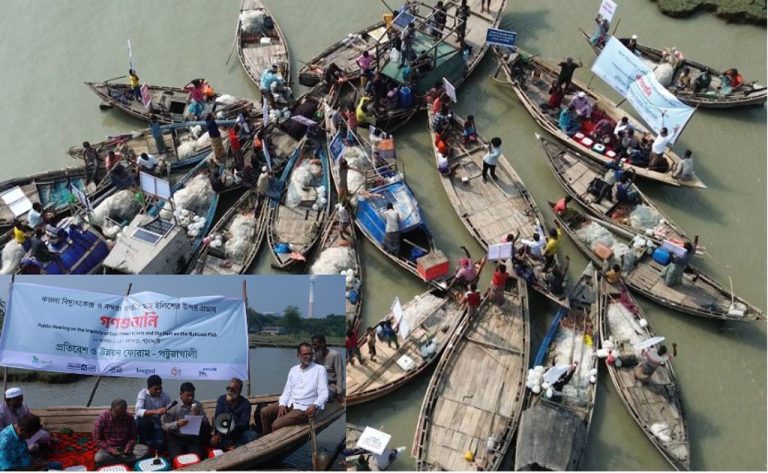
A crucial public hearing was held on November 10, 2025, at 10:00 AM on the Andharmanik River in Kalapara, Patuakhali, to demand the protection of the national fish, Hilsa, and the preservation of the coastal environment. Organized jointly by Forum on Ecology and Development (FED)- Patuakhali, PRANTOJON, CLEAN, and BWGED, the event saw participation from local fishing families and civil society representatives. Speakers at the hearing highlighted that the unplanned mega-development centering on coal power plants and port activities in the Kalapara region has brought the Andharmanik River, a Hilsa sanctuary, to the brink of becoming completely Hilsa-free.
The panel of judges included Dr. Mohammad Ashraful Hoque (Senior Scientific Officer, BFRI), Asim Abrer (Lecturer, Department of Coastal Studies and Disaster Management, University of Barisal), Shubhankor Chakrabarty (Convener, Barishal Divisional Environment and Public Safety Forum), Advocate Subash Chandra Das (Forum on Ecology and Development (FED)- Barishal), and Mezbahuddin Mannu (Member, Ecology and Development (FED)- Patuakhali).
Present at the public hearing were Amal Mukherjee, Convener, Ecology and Development (FED)- Patuakhali; Tauhedul Islam Shahzada, Executive Director, Prantjon;
Among the fishing families, Abdur Rob Radhi, a fisherman for 55 years, lamented that their fishing was stopped due to the construction of the Payra Port channel in the adjacent Ramnabad River, affecting about 1,000 fishermen without any compensation, making survival difficult.
The organizing bodies reported a significant decline in Hilsa production, noting that while stable until the 2020–21 fiscal year, the national production dropped by 42,000 metric tons (an 8% decrease) from FY 2022–23 to FY 2023–24, marking the lowest production in six years. Barishal Division, which accounts for approximately 65% of the total Hilsa catch, also experienced a significant decline of about 23,509 metric tons in FY 2023–24. The once-abundant Andharmanik River, declared a sanctuary in 2011, is now rarely yielding Hilsa, underscoring a deep crisis. At the core of this problem is the unplanned development surrounding coal power plants and ports. Speakers emphasized that untreated industrial waste and hot water discharged directly into the rivers from power plants and other infrastructure are major contaminants. Fisheries experts noted that Hilsa are highly sensitive to pollution, which is disrupting their breeding, leading to smaller fish and their migration from the area. The water and soil of the Ramnabad, Andharmanik, and Tiakhali rivers are now rated at moderate to high risk due to this pollution.
Furthermore, increased vessel traffic for the port is obstructing the Hilsa’s main access route from the Bay of Bengal. The construction of three successive bridges within just 8 to 10 kilometers on the Andharmanik River, along with the closure of the mouths of tributary rivers, is impeding the river’s natural flow, reducing navigability, and severely hindering the Hilsa’s free movement and breeding. Additionally, free-style sand filling along the river banks and illegal encroachment are further threatening the river’s existence. This environmental catastrophe has severely endangered the lives and livelihoods of the fishing communities. Representatives of local fishing families expressed their frustration, stating that hundreds of fishermen are being forced to change their profession due to dwindling opportunities, highlighting the severity of the crisis.
To resolve this critical environmental crisis and protect the national resource Hilsa, the public hearing issued urgent demands to the government and concerned authorities: Strict international-standard environmental criteria must be ensured regarding the discharge of power plant waste and hot water into the river. Infrastructural planning must be finalized based on the advice of fisheries experts, securing Hilsa breeding grounds. Vessel traffic and construction must not obstruct Hilsa breeding and migration routes, and Environmental Impact Assessments (EIAs) covering Hilsa and marine biodiversity must be conducted before final approval of any mega-project. Finally, encroachment, pollution, and filling of the Andharmanik River must be immediately stopped by demarcating its boundaries, and initiatives must be taken to restore the river’s navigability through dredging. The organizers hope this public hearing will compel the relevant authorities to take immediate, effective, and strict action to protect Kalapara’s environment and natural resources.