
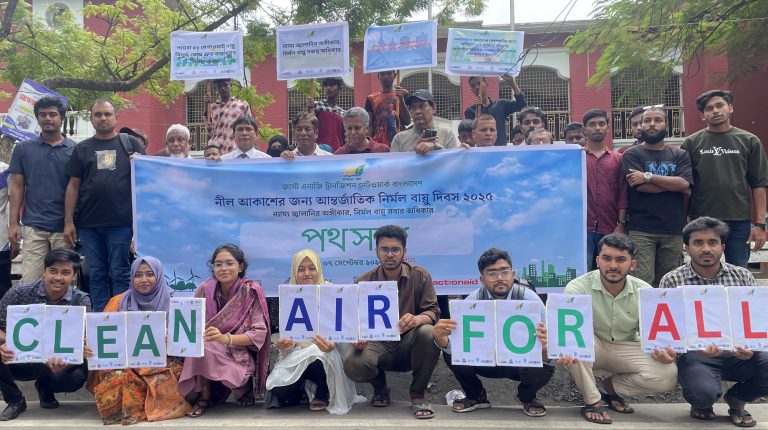
September 7, 2025: The International Day of Clean Air for Blue Skies. The United Nations General Assembly has decided to observe this day to improve air quality for the protection of human health. On the occasion of this day, with the support of ActionAid Bangladesh and the Justice Energy Transition Network Bangladesh (JETNET BD), member organizations Prottoy Jon, Abash, Arohi, Silt, and the Barisal Divisional Environment and Public Safety Forum organized a street assembly at 10 AM in front of the Barisal Ashwini Kumar Town Hall. The assembly was chaired by the retired Principal, Mr. Aminur Rahman Khokon.
Recognizing the necessity of clean air for life, the constant global occurrence of air pollution, the extreme impact of air pollution on human life and the environment, and the critical state of air pollution in the world today and the urgent need to overcome it, the United Nations has designated an international day titled ‘Clean Air for Blue Skies’. According to a resolution adopted at the 74th session of the UN General Assembly on December 19, 2019, this day is observed worldwide every year on September 7.
At the street assembly, the Convener of the Barisal Divisional Environment and Public Safety Forum, Mr. Shubhankar Chakraborty, said that air pollution is one of the top five causes of death in the world today; nearly 7 million people die prematurely each year worldwide due to air pollution, which is far higher than the number of deaths from any other environmental pollution. Not only that, illness from air pollution greatly reduces human productivity, the financial cost of which is immense.
The Executive Director of Arohi, Mr. ATM Khorshed Alam, said that the alarming fact is that the harmful effects of air pollution are not limited to human health; its impact on the animal kingdom and plants is also severe. Furthermore, air pollution plays a significant role in climate change, especially black carbon and ozone, which are called ‘Short-Lived Climate Pollutants’ (SLCPs) due to their role in climate change. Despite such multifaceted harmful effects of air pollution, there is no international treaty or agreement yet to control it. In this reality, increasing global public-political awareness and taking effective international action to control air pollution is now a demand of the time. In that regard, the international day dedicated to clean air is highly significant and important.
The Executive Director of Prottoy Jon, Mr. Touhidul Islam Shahajada, said that based on survey data, it is known that 90% of the world’s population now lives in air deemed unsafe by the World Health Organization (WHO). The picture of air pollution in some regions, especially in our Asian continent, is even more terrifying; in a list prepared by the World Health Organization after reviewing the air quality levels of about 1600 cities worldwide, all of the top 20 most polluted cities are in our South Asia. Although only Narayanganj from Bangladesh is included in those top 20 cities. In this situation, there is no alternative to taking initiatives to control air pollution through laws, agreements/understandings at the national, regional, and international levels. For this, the draft ‘Clean Air Act’ prepared by the Bangladesh government needs to be finalized swiftly and implemented as law.
The Convener of the Barisal Environment and Development Forum, Mr. Subash Dutta, said that air pollution does not respect national borders. It has a more harmful effect on women, children, and the elderly comparatively. Air pollution also has harmful effects on the ecosystem. Many air pollutants directly impact the climate crisis. On the other hand, improving air quality has a positive effect on mitigating the climate crisis.
A member of the Barisal Environment and Development Forum, Mr. Akhtarul Kabir, said that due to air pollution, not only health is being damaged, but the country’s economy is also suffering. A report by the international environmental organization Greenpeace revealed that air pollution causes an annual financial loss of Tk 1,17,600 crore in Bangladesh, which is about 5 percent of the country’s GDP. Above all, the country’s reputation is being tarnished due to air pollution. A negative attitude is forming in the world community regarding Bangladesh.
The Chair of the street assembly, retired Principal Mr. Aminur Rahman Khokon, said that countless people die from air pollution caused by fossil fuels. Air pollution caused by fossil fuels must be stopped. Developed countries that provide economic cooperation for fossil fuel projects in developing countries should also encourage them to reduce air pollution.
Several demands were raised from the street assembly:
-
Commitment to Just Energy, Clean Air is Everyone’s Right.
-
A solar power plant must be built on the land acquired for the Ashuganj Company in Kolapara, instead of a fossil fuel-based plant.
-
The Payra 50 MW Wind Power Plant must be implemented quickly.
-
The Payra 1320 MW Thermal Power Plant (2nd Phase) must be canceled.
-
The ‘Clean Air Act’ must be implemented swiftly.
Representatives of civil society, local school-college students, NGO workers, members of women’s organizations, farmers, journalists, environmental activists, businesspeople, and the general public participated in the street assembly. They held placards and banners with various written slogans.